Wheel bearing noise: symptoms and when to replace it
You join the motorway, settle at 50 mph and notice a steady hum that was not there last week. You turn the radio up, and the sound is still underneath it. A wheel bearing is the component that lets the wheel spin on its hub with almost no friction while carrying the weight of the car. When it wears, the first sign is wheel bearing noise that rises with road speed and changes as you corner. This guide covers how to recognise it, whether it is safe to keep driving and when replacement makes sense.
If the hum appears above a certain speed and changes when you steer, get it looked at early: find your nearest MOTRIO garage and ask for a wheel and hub check.
What is a wheel bearing and where is it fitted
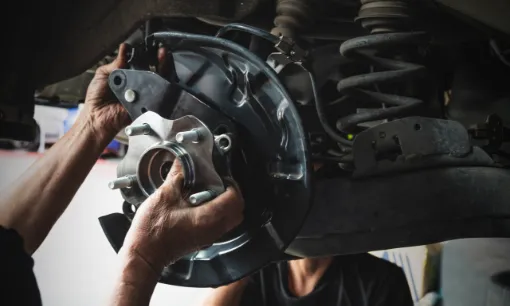
A wheel bearing sits inside the hub, the assembly the wheel bolts onto. It does two jobs: it lets the wheel rotate with minimal friction, and it passes the weight of the car and the cornering loads through to the suspension.
On modern cars the bearing is built into a sealed hub unit, greased for life and fitted with the magnetic encoder ring the ABS sensor reads to measure wheel speed. Replacement therefore involves the complete unit rather than the races on their own.
Wheel bearings have no service interval. A healthy one often passes 90,000 miles, but working conditions matter more than mileage: potholes, kerb strikes, speed bumps taken too fast and winter salt attacking the seal all bring failure forward.
Wheel bearing noise: how to recognise it
Wheel bearing noise is a continuous hum, closer to a drone or distant aircraft than to a knock. What sets it apart from every other noise is that it tracks road speed rather than engine revs. Change down a gear and the engine rises in pitch while the hum stays where it was, which points straight at the wheels.
The second clue is what happens in a bend. Steering shifts the car's weight onto the outside wheels and loads the bearing on that side, so a noisy wheel bearing that gets louder on a right-hand turn is usually the left one. A gentle weave at steady speed on an empty road normally confirms it.
Noise alone is not a diagnosis. Feathered tyre wear produces a very similar drone, worn dampers add a rumble of their own and a binding brake pad hums too. Ruling out the most common car suspension problems narrows it down before any part is replaced.
Failing wheel bearing symptoms beyond the noise
Noise arrives first, but it seldom stays on its own. Wheel bearing symptoms build up as internal play increases, and these five are the most common.
- Play in the wheel: with the car safely raised, the wheel rocks front to back when gripped top and bottom.
- Vibration through the steering wheel or floor, steady and tied to road speed.
- ABS warning light on, because the sensor built into the bearing loses its reading.
- Uneven tyre wear on one wheel only.
- A hot hub to the touch after a short drive, which points to excess friction.
Uneven wear on a single tyre has more than one possible cause. Where bearing play is slight, the geometry is usually the culprit, so a wheel alignment check is the right next step.
Is it safe to drive with a noisy wheel bearing
A noisy wheel bearing will not strand you overnight, but it is not a fault to postpone either. While the hum is the only symptom the car remains drivable. Once play appears in the wheel, driving should be kept to what is strictly necessary.
A bearing with play changes how the wheel sits against the road: steering loses precision, braking can feel less settled and the built-in ABS sensor may send inconsistent readings, which sometimes shuts down ABS and stability control. In advanced and rare cases the bearing can seize.
There is a practical argument too. Excessive play in a wheel bearing is a failure item on the annual test, so a bearing that already hums is likely to cost you a retest. The MOT checklist is worth a look if your test date is close.
Wheel bearing replacement: front, rear and hub units
Wheel bearing replacement is not a scheduled job: it happens when noise, play or vibration turns up, and no mileage figure calls for changing a quiet bearing as a precaution.
The front wheel bearing fails more often, because the front axle carries most of the weight, absorbs steering loads and, on a front-wheel-drive car, transmits engine torque. Rear bearings live an easier life and often come as a complete hub that bolts off in fewer steps. Only the affected side needs replacing: unlike dampers, bearings are not changed in pairs.
The job typically takes one to two hours per wheel. Bolt-on hub units are straightforward, while pressed-in bearings need a press and a hub nut torqued to the manufacturer's figure, which determines how long the new part lasts. Where suspension components come apart, the geometry and the condition of the suspension are worth checking at the same time.
Wheel bearing replacement cost depends on whether the wheel is front or rear, on whether the car takes a bearing alone or a complete hub unit, and on the labour time specified for that model. An accurate figure comes from a quote on the vehicle.
Wheel and suspension checks at MOTRIO garages
Motrio garages check bearings, hubs and wheel play during routine servicing and as part of any diagnosis involving noise or vibration, starting by identifying which wheel is at fault.
Motrio is a network of independent garages within Renault Group. Technicians work across all makes and models, parts meet manufacturer specifications and the work carries a 1-year warranty on parts and labour. A wheel check also covers tyres and tread condition.
If you can hear a hum that builds with speed, or feel a vibration through the steering, book a check at your nearest Motrio garage.