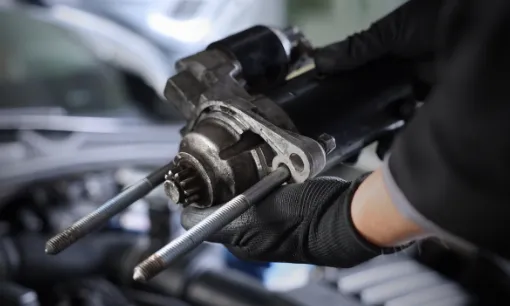
Starter motor: failure symptoms and common causes
You turn the key and hear a single sharp click. Then nothing. The dashboard lights are on, the radio works, but the engine will not turn over. That is the classic sign of a starter motor that has given up.
A starter motor is the electric motor that spins the engine over until it fires, drawing 150 to 300 amps from the battery for about a second. The most common starter motor symptoms are a single click when you turn the key, a metallic grinding noise and a whirring sound with no engine movement at all. This guide explains where the starter motor is located, the symptoms to listen for, what makes one fail and how long a starter motor lasts.
If your car has started getting slower to fire up, it is worth acting before it strands you: book a starting system check at a MOTRIO garage.
What is a starter motor and where is it located
A starter motor converts electrical energy from the battery into mechanical movement. When you turn the key, an electromagnet called the solenoid pushes a pinion gear forward so it meshes with the flywheel ring gear and turns the crankshaft until combustion takes over.
The whole cycle lasts little more than a second, but it is the single biggest electrical demand the car ever makes. That is why a tired starter shows itself first on cold mornings, when the oil is thick and there is more resistance to overcome.
Where the starter motor is located: it is bolted to the engine block where the gearbox meets the engine, almost always low down and to one side. On many cars it can only be reached from underneath or after removing undertrays and intake parts.
A car starter motor handles roughly 30,000 to 50,000 start cycles over its life. Stop start city driving works it far harder than long motorway runs.
Starter motor symptoms: the clicking noise and what it means
The noise tells you most of what you need to know. A single, solid click means the solenoid is engaging but the motor is not turning, usually because the internal contacts are burnt or the brushes are worn down.
Rapid repeated clicking is a different story. It points to low voltage rather than a failed starter, so the battery or a corroded terminal is the more likely culprit.
A metallic grinding noise means the pinion is not meshing cleanly with the ring gear. A high pitched whirring with no engine movement means the pinion is not extending at all and the motor is spinning freely.
Intermittent faults are the hardest to pin down. If the car starts on the second or third attempt and then behaves for a week, worn brushes are usually nearing the end of their travel. That pattern tends to appear weeks before total failure, and the guide on what to do in a car breakdown is worth reading before it happens.
What causes a starter motor to fail
Most starter motor problems come down to four causes, and wear is behind all of them.
Worn brushes are the most common. They are carbon contacts that wear down with every start, and once they no longer press firmly on the commutator the motor loses the current it needs.
Burnt solenoid contacts come second. Every start cycle produces a small arc across the contacts, and after tens of thousands of cycles the surfaces pit and stop conducting reliably.
Oil contamination is the cause people overlook. A leaking crankshaft seal or sump gasket above the starter lets oil soak into the unit, where it degrades the insulation and clogs the pinion mechanism. Catching a leak at a routine vehicle service prevents that.
Heat and repeated short trips finish the list. A starter that never gets a chance to cool between attempts ages faster, and so does one fitted close to the exhaust manifold.
Starter motor or battery? Getting the diagnosis right
The headlight test settles it in seconds. Switch the lights on and turn the key: if the headlights stay bright, the battery has plenty of charge and the starter is the suspect. If they dim heavily or go out, the problem is electrical supply.
Next, check the terminals. A white or greenish deposit on the battery posts raises resistance and can starve the starter of current, producing symptoms identical to a mechanical fault. Cleaning the terminals sometimes solves the whole problem.
Then look at the pattern. A battery that goes flat again after charging suggests a charging fault instead, so the alternator is the part to check, since it is what puts energy back in while you drive.
How to test a starter motor properly: a workshop measures voltage drop between the battery and the starter while the engine is cranked. If the battery holds above 10 volts and the starter still does nothing, the unit itself has failed.
How long does a starter motor last and when to replace it
A starter motor usually lasts between 100,000 and 150,000 miles, which on most cars is more than ten years. Frequent short journeys, a weak battery and oil contamination all shorten that figure considerably.
Starter motor replacement is the right call when the armature is burnt out, when the pinion has damaged the flywheel ring gear or when the solenoid contacts are too far gone to refurbish. Reconditioning, meaning new brushes, contacts and bushes in a sound body, is an option on older vehicles.
The job normally takes one to three hours depending on access. On engines where the starter sits under the inlet manifold, removal takes noticeably longer.
Before any part is ordered, the battery and earth straps should be measured. Plenty of starter motors are replaced when the real fault was a loose earth cable or a battery with no cranking power left.
Starter motor diagnosis and replacement at a MOTRIO garage
Motrio garages test the whole starting circuit: battery capacity under load, cable and earth condition, starter current draw and solenoid operation. That tells you whether the unit needs replacing, reconditioning or simply a better connection.
Motrio is a network of independent garages backed by the Renault Group, using quality parts and offering a 1-year warranty on parts and labour.
If your car is slow to start or has already left you stranded, book a starting system check at your nearest Motrio garage and ask for a quote.