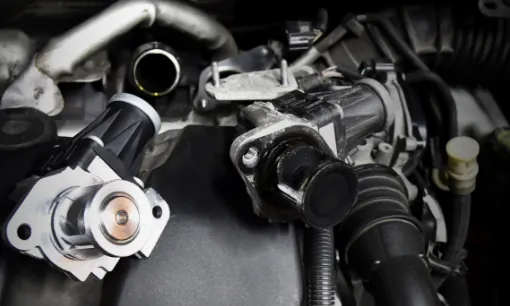
EGR valve: blocked valve symptoms and cleaning
The car feels flat when you accelerate, the idle is rough and the engine management light has been on for days. On a diesel that spends most of its life on short urban trips, one component comes up again and again: the EGR valve.
An EGR valve recirculates part of the exhaust gas back into the intake to lower combustion temperature and cut nitrogen oxide emissions. Depending on engine design and operating conditions, EGR rates range from around 5% to over 30% of the gas the engine produces. When it clogs, the symptoms are clear: power loss, unstable idle, black smoke and a lit engine management light. This guide covers what an EGR valve does, where it is located, how cleaning works, why removal fails the MOT and when replacement is the only option.
If the engine light is on and the car feels down on power, start by reading the fault codes: vehicle diagnostics at a MOTRIO garage.
What is an EGR valve, what does it do and where is it located
EGR stands for Exhaust Gas Recirculation. The valve takes a share of burnt exhaust gas and feeds it back into the intake, where it displaces some of the fresh air. Less oxygen means a cooler burn, and a cooler burn produces far fewer nitrogen oxides.
What an EGR valve does in practice: it works mainly at light and medium load, when combustion temperatures would otherwise be high. Under hard acceleration it closes, because the engine needs all the air it can get.
Where the EGR valve is located: between the exhaust manifold and the inlet manifold, joined to both by a short pipe. Many engines pair it with an EGR cooler that drops the gas temperature before recirculation, and on some units it sits beneath the inlet manifold, so other parts must come off to reach it.
Two types are common. Pneumatic valves are found on older engines, while electronic valves controlled directly by the ECU are now standard. Electronic valves report their position back to the system, so a jam almost always sets a specific fault code.
Blocked EGR valve symptoms and the engine management light
Exhaust gas carries soot and oil vapour. Over the miles those residues build a carbon layer that narrows the passage and eventually jams the valve open or shut. The EGR valve symptoms depend on which way it sticks.
Stuck open, the engine receives exhaust gas when it should not: the idle becomes lumpy, the car hesitates on acceleration, black smoke appears and fuel consumption rises. Stuck closed, recirculation stops entirely, combustion runs hotter and the car may drop into limp mode on a motorway climb.
There is no dedicated EGR warning symbol. What lights up is the amber engine management light, usually alongside a fault code for insufficient or excessive EGR flow. Limp mode with a capped rev limit is common and should not be left for weeks.
Less obvious signs include a harsh smell from the exhaust, harder cold starting and a failed emissions reading, which is one of the checks covered in the MOT checklist.
EGR valve cleaning: when it works and when replacement is needed
There are two approaches. The first uses an EGR valve cleaner sprayed into the intake with the engine running. It dissolves surface deposits, works well as preventive maintenance and takes very little time, but it will not free a valve that has already seized.
The second means removing the unit and cleaning it by hand or in an ultrasonic bath. This is the only method that reaches hardened carbon, and it also allows the recirculation pipe and the EGR cooler to be checked, since those are often just as blocked as the valve itself.
How to clean an EGR valve at home is a popular search, and the honest answer has limits. Aerosol products only act on what they can reach, so on an electronic valve with a seized internal motor no cleaner will restore movement.
One step is easy to miss. After removal, many engines need the valve adaptation reset with a diagnostic tool. Without it the ECU keeps using old learned values and the fault code stays stored.
Why EGR removal will fail your MOT
EGR delete kits are easy to buy online and come with promises of a freer breathing engine. The real gain is marginal and the consequences are not.
A vehicle type approved with an exhaust gas recirculation system has to keep it. Disabling the valve mechanically or through remapping makes the car non compliant with its approval, and using it on the road in that state is an offence under construction and use rules.
Since May 2018 the MOT includes checks on emissions control equipment, and a missing or obviously modified emissions component records a major defect, which is a fail. Diesel vehicles also face tighter smoke limits, so tampering frequently shows up in the reading itself.
There is a technical downside too. Without recirculation, combustion temperatures and nitrogen oxide emissions rise significantly, increasing the environmental impact of the vehicle and potentially affecting the calibration of the engine and emissions control systems. Putting a car back to standard after a delete usually takes more work than maintaining it properly would have, and the guide on what makes a low emission vehicle explains why these systems matter beyond the test.
When cleaning is not enough and the EGR valve needs replacing
EGR valve replacement is the right answer when the internal actuator has seized, when the valve seat is heat distorted or when the fault returns shortly after a full clean. A valve in that condition cannot be repaired, only renewed.
The diagnosis should cover the whole circuit. A blocked EGR cooler, a failed differential pressure sensor or a sticking variable geometry turbo produce very similar symptoms, and replacing the valve alone would fix nothing.
Fitting time varies widely with the engine layout, from under an hour where the valve is exposed to half a day where the inlet manifold has to come off first.
Prevention works better than either option. Regular runs long enough to bring the engine to full temperature, oil that meets the manufacturer specification and filters changed on schedule all slow the build up. It is worth checking the lambda sensor at the same time, since it belongs to the same emissions management system.
EGR valve checks and cleaning at a MOTRIO garage
Motrio garages read the stored fault codes, compare requested and actual EGR flow and position, and decide whether cleaning will hold or the valve needs replacing. After the work, the valve adaptation is reset and the codes are cleared.
Motrio is a network of independent garages backed by the Renault Group, with professional diagnostic equipment, quality parts and a 1-year warranty on parts and labour.
If your engine light is on or your diesel feels short of power, book an EGR system diagnostic at your nearest Motrio garage and ask for a quote.