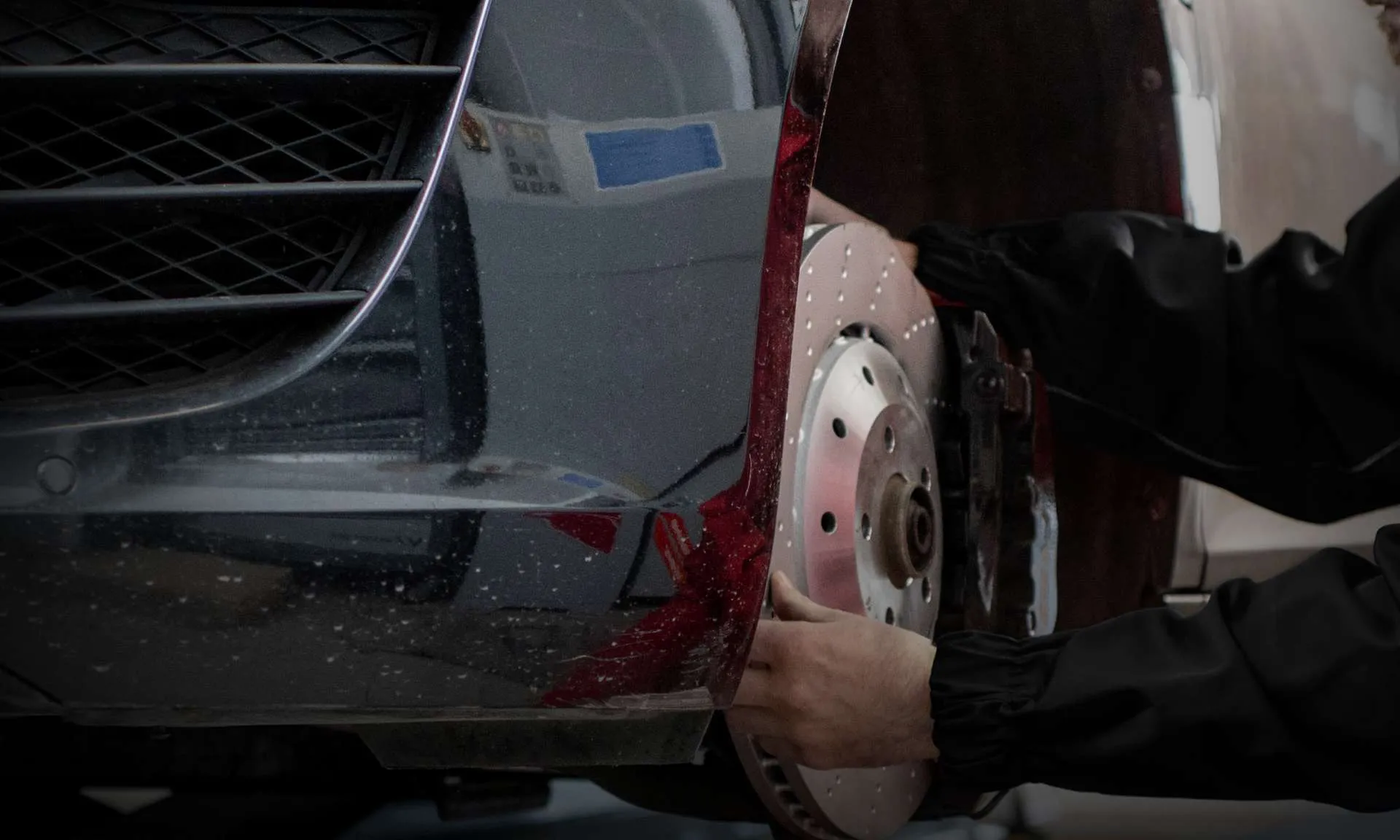
How often should you change your brake discs?
Braking that feels less sharp than usual, a metallic squeal, a slight vibration through the pedal: brake discs almost always give warning signs before they fail. On average, brake discs wear out between 60,000 and 80,000 km, but that figure varies a lot with how and where you drive. This article covers how to tell if your discs need replacing, and how often to change them.
If you feel vibration when braking or your stopping distances are getting longer, it is best to have the system checked without delay: find your nearest MOTRIO garage and book a brake inspection.
How to tell if your brake discs are worn
Brake discs, together with the pads, are the heart of the braking system. Every time you press the pedal, the pads clamp the disc that spins with the wheel: that friction is what slows the car down. Like any part exposed to friction, the disc gets thinner over time.
Several signs should alert you: a squeal or metallic noise when braking, vibration through the pedal or steering wheel, stopping distances that lengthen, or a pedal that feels softer than usual. A warped disc deserves particular attention: when the surface is no longer perfectly flat, the car pulses with each wheel rotation and you feel a regular vibration under braking.
A visual check already gives good clues. A pronounced lip on the edge of the disc, deep scoring, a bluish tint from overheating or cracks all call for replacement. Every disc has a minimum thickness marked by the manufacturer: below that figure it must be changed, always in pairs on the same axle for balanced braking. Because discs wear more slowly than brake pads, they are usually replaced at the second or third set of pads.
Not all discs are the same. Most recent cars use ventilated discs at the front, which shed heat better, while the rear usually keeps solid discs. Some sporty or heavier models fit drilled or grooved discs: they cool more effectively but tend to wear the pads faster. Knowing which type your car has helps you judge what to expect in terms of lifespan.
Your driving style also matters a lot. Late, hard braking, downhill routes and a frequently loaded car heat the system and speed up wear. A steady high-pitched squeal can be the pad wear indicator, while a metallic grinding means the friction material is gone and the backing plate is working straight onto the disc.
Wear is not always even: a caliper that is slow to release wears one side of the disc more than the other. An ABS or brake warning light should be checked at once, as it can point to a system fault. New discs also need bedding in with a few gentle stops over the first miles, to settle the friction material.
How long do brake discs last?
In mixed use, brake discs last on average between 60,000 and 80,000 km, against around 30,000 km for front pads. Town driving, with frequent braking, shortens these distances; motorway miles and smooth driving extend them. On hybrids and electric cars, regenerative braking spares the discs, which can last far longer.
While you are there, have the brake fluid checked too, as it should be replaced roughly every two years. Brakes are also assessed during your vehicle service and your brake fluid change: discs that are too worn can lead to problems, including at the MOT. Replacing discs affects safety and needs the right tools, so it is a job for a professional.
A few habits make discs last longer. Brake gradually and use engine braking on descents, avoid resting your foot on the pedal while driving and do not overload the car. Fitting quality pads and replacing them in time also protects the discs, because a worn pad quickly ruins the disc surface.
Acting at the first signs prevents further damage. If you let fully worn pads keep working, you risk having to replace discs that could still have been saved and, in the worst cases, the calipers. A brake check measures the remaining thickness in minutes and assesses discs, pads and fluid, so you only replace what genuinely needs it.
The garage will say whether it is worth changing discs and pads together, as is often the case. Asking to have the remaining thickness measured at each service lets you plan the work in advance, instead of being forced into an urgent repair.
Brake disc inspection and replacement at a MOTRIO garage
MOTRIO is a network of independent garages, part of Renault Group, with workshops across the UK. MOTRIO garages measure disc thickness, pad wear and the condition of the calipers, then replace parts with references that meet your manufacturer's specifications, backed by a 1-year warranty on parts and labour.
If you hear a metallic noise when braking or your stopping distances are lengthening, do not wait: book at your nearest MOTRIO garage and drive away with safe brakes and a clear quote.