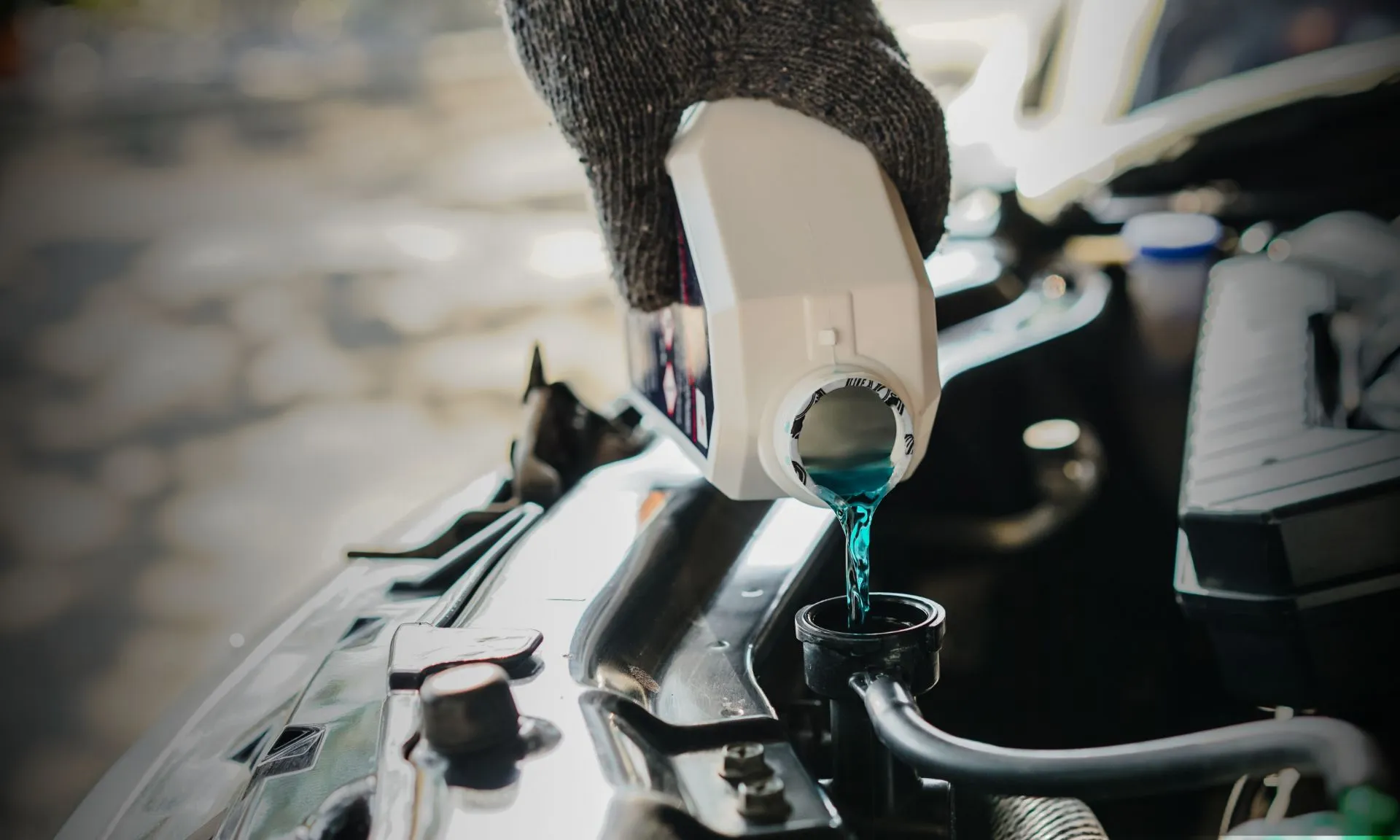
Coolant for car: which type to use and when to change it
You pop the bonnet for a quick check and notice the coolant reservoir is almost empty. Or you spot a small coloured puddle under the car after a long stop. Car coolant is one of those fluids most drivers never think about, until something stops working as it should. And yet it's one of the most important protections for the engine. Let's look at what it does, how often it should be changed, and how to choose the right one for your car.
What does car coolant do and how do you check the level?
Coolant for car is a technical fluid that flows through the cooling circuit of the engine. It has three main jobs: absorb the heat produced by combustion, protect metal parts against corrosion, and stop the fluid from freezing in winter thanks to its antifreeze component. People often call it just antifreeze, but in reality it's a year-round mix that works in both summer and winter.
Colour isn't a style choice. Coolants come in green, red, blue, pink or orange, and each colour points to a specific chemical formulation (IAT, OAT, HOAT and so on). Working out what coolant for my car is right means checking the handbook: mixing two incompatible types can cause deposits, lose the anti-corrosion properties and damage the water pump. The rule is simple — use the type specified by the manufacturer, and don't top up with whatever happens to be on the shelf.
To check the level, look at the reservoir when the engine is cold — that is, after the car has been parked for at least a couple of hours. The tank is translucent and marked with MIN and MAX lines. If the coolant sits below the MIN line, or if you keep needing to top it up, it's time for a workshop check: a steady drop almost always points to a leak somewhere in the circuit.
Which coolant does my car need and when should it be changed?
What coolant does my car need is answered, first and foremost, by the owner's handbook. The manufacturer lists the exact specification (G11, G12, G12+, G13 and equivalents) and most modern UK cars use a long-life OAT or HOAT coolant. Most manufacturers recommend a full change every 4 to 5 years or every 60,000 miles, whichever comes first. Some long-life formulations can last up to 100,000 miles, but the time limit still applies: the anti-corrosion additives degrade with age, even if the car is rarely driven.
Between full changes, a top-up is sometimes all you need.Even if the loss seems small and occasional, it’s always worth having it checked at a workshop: even a minor leak from the water pump, the radiator or a hose can worsen over time and should not be ignored. A coolant check is often included as part of a routine car service, along with the brake fluid and oil.
On price: a 1-litre bottle of engine coolant for my car costs between £8 and £20 depending on the quality and specification. A full change at a workshop, including system flush and labour, typically runs between £50 and £100 for a standard car. The job usually takes 30 to 60 minutes.
A signal you should never ignore is the engine temperature. If the needle climbs towards the red zone or the temperature warning light comes on, pull over safely and stop driving. Continuing with an overheating engine can damage the cylinder head and gasket, repairs that cost far more than a preventive check.
Car coolant check and top-up at a Motrio garage
Motrio garages carry out coolant level checks and full changes as part of routine servicing, using products that match your manufacturer's specifications. Before any change, the technicians check the circuit for leaks, so any small problem is spotted early.
Motrio is a network of independent garages backed by the Renault Group, with workshops across the UK, fast turnaround and transparent pricing. If it's been more than four years since your last coolant change, or you've noticed the level dropping, find your nearest Motrio garage and book a check.